The presidential directive orders the Federal Aviation Administration to replace the 1973 blanket overland Mach 1 speed ban under 14 CFR Part 91 with a decibel-based acoustic certification standard while opening joint military-civil test ranges.
WASHINGTON — President Donald Trump on Friday signed a sweeping executive directive instructing the Department of Transportation, the Federal Aviation Administration (FAA), and the Department of Defense to establish six high-speed commercial aerospace testing corridors across the western and southwestern United States while modernizing federal regulations governing civil supersonic flight.
Invoking presidential airspace management authorities under 49 U.S. Code § 40103 and aircraft acoustic rulemaking mandates under 49 U.S. Code § 44715, the order directs the FAA Administrator to publish a final acoustic certification rule within 120 days replacing the agency’s 53-year-old blanket prohibition on civil overland supersonic flight codified in 14 CFR Part 91 (§ 91.817).
For more than five decades, federal aviation regulations have banned civil aircraft from exceeding Mach 1 over the continental United States regardless of how quiet the aircraft’s ground acoustic signature actually is. Aerospace engineers and defense officials have warned that this rigid regulatory barrier has forced American supersonic airframe and propulsion innovators to conduct flight testing overseas or within congested offshore tracks, ceding critical propulsion leadership to state-subsidized European and Chinese aerospace consortia.
Replacing the 1973 Speed Ban With Acoustic Performance Standards Under 49 U.S. Code § 44715
When the FAA first enacted 14 CFR § 91.817 in March 1973, first-generation supersonic transports such as the Anglo-French Concorde and the Soviet Tu-144 generated intense N-wave sonic booms exceeding 105 perceived level decibels (PLdB) on the ground—loud enough to rattle windows across a 50-mile swath beneath the flight path. However, breakthroughs in computational fluid dynamics, elongated carbon-composite fuselages, and top-mounted propulsion inlets now allow next-generation aircraft to shape shockwaves so they dissipate before reaching the ground, producing a soft acoustic “thump” quieter than ambient highway traffic.
Under Friday’s presidential directive, the Department of Transportation and the Department of Defense must implement three core regulatory and operational reforms:
- Decibel-Based Overland Supersonic Certification (14 CFR Part 91): Directs the FAA under 49 U.S. Code § 44715 to replace the absolute Mach 1 speed limit over land with an objective acoustic threshold permitting commercial supersonic cruise above Flight Level 450 whenever an aircraft demonstrates a ground perceived noise level below 75 PLdB.
- Joint DoD-FAA High-Speed Testing Corridors (49 U.S. Code § 40103): Opens dedicated high-altitude supersonic and hypersonic flight test corridors linking Edwards Air Force Base in California, White Sands Missile Range in New Mexico, and Nellis Air Force Range in Nevada, granting certified domestic aerospace manufacturers streamlined 14-day flight test clearances.
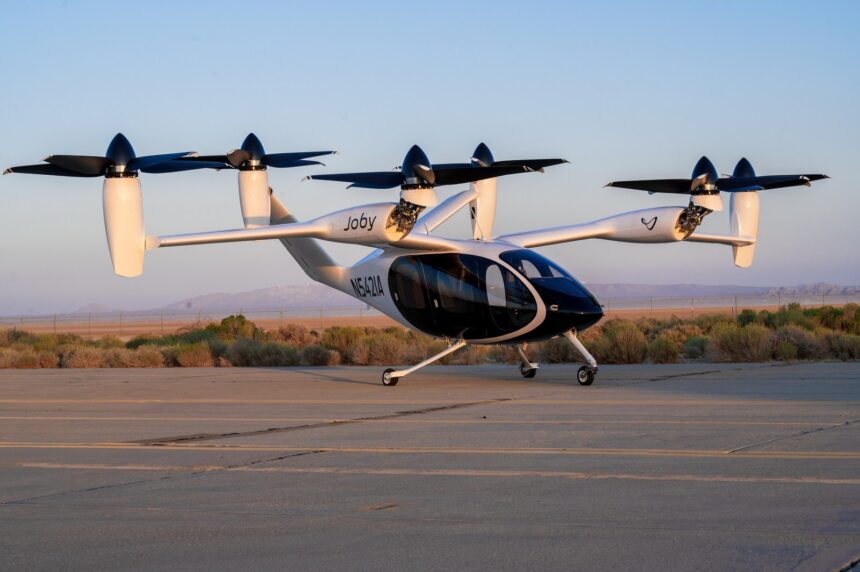
- Accelerated Type Certification for Advanced Air Mobility (AAM): Establishes a unified FAA-Pentagon airworthiness reciprocity protocol allowing electric vertical takeoff and landing (eVTOL) and autonomous cargo aircraft validated under military Agility Prime testing to fast-track civil type certification.
The aerospace modernization order builds directly upon the administration’s broader industrial and defense-base revitalization strategy, following Thursday’s directive enforcing domestic steel procurement and Title XI ship financing for American shipyards and Tuesday’s Defense Production Act order expanding domestic rare earth refining for defense and aerospace turbines.
Unlocking Domestic Aerospace Manufacturing and Dual-Use Propulsion
Senior White House and Pentagon officials emphasized during a Friday morning briefing that commercial supersonic and high-Mach aviation carries profound national security implications. The high-temperature titanium alloys, ceramic matrix composites, and medium-bypass turbofan engines required for commercial Mach 1.7 passenger and executive transport share direct supply-chain and workforce overlap with tactical military aviation and long-range strike platforms.
“For over half a century, Washington bureaucrats regulated aviation based on 1960s slide-rule technology, punishing American engineers for solving the sonic boom,” the Transportation Secretary said at the signing ceremony. “By shifting from an arbitrary speed ban to a science-based decibel standard under 49 U.S. Code § 44715, we are ensuring that the next generation of supersonic airliners and autonomous airframes are designed, tested, and built in American factories.”
Prior to Friday’s action, domestic aerospace firms developing supersonic demonstrators in Colorado, California, Texas, and Georgia faced up to 18 months of environmental assessments and ad-hoc special flight authorizations under 14 CFR Part 91 Appendix B simply to conduct a single supersonic test flight. Under the new joint-use framework, pre-cleared corridors above 30,000 feet across federal range complexes will operate under standing programmatic environmental clearances.
Industry Response and International Aviation Standards
The Aerospace Industries Association, the General Aviation Manufacturers Association, and domestic propulsion suppliers praised the executive directive, projecting that clear overland certification rules will unlock more than $14 billion in private venture and aerospace manufacturing capital across the United States over the next five years. Industry executives noted that commercial operators are particularly eager to deploy low-boom supersonic aircraft on transcontinental routes between New York, Dallas, Seattle, and Los Angeles, cutting coast-to-coast travel times from five hours to just over two and a half hours.
The directive also instructs the U.S. delegation to the International Civil Aviation Organization (ICAO) to press foreign aviation authorities to adopt the American decibel-based certification benchmark as the global baseline for commercial supersonic operations, preventing European regulators from erecting protectionist acoustic barriers against U.S.-built aircraft.
Sources & Official Documentation
- Legal Information Institute (Cornell Law School) – 49 U.S. Code § 40103 – Sovereignty and Use of Airspace and Air Traffic Management Authority
- Legal Information Institute (Cornell Law School) – 49 U.S. Code § 44715 – Controlling Aircraft Noise and Sonic Boom Standards
- Electronic Code of Federal Regulations (eCFR) – 14 CFR Part 91 – Federal Aviation Administration General Operating and Flight Rules (Subpart I Noise & Sonic Boom Limits)