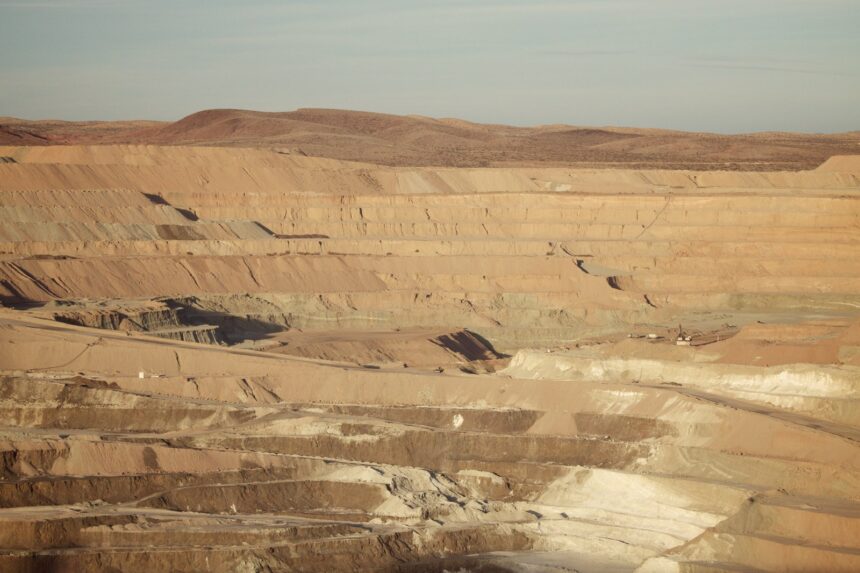
The directive mobilizes $1.8 billion in federal off-take guarantees and capital grants under Title III to eliminate Chinese monopolies over defense-critical neodymium and samarium-cobalt magnets.
WASHINGTON — President Donald Trump on Wednesday signed an executive order invoking emergency industrial mobilization authorities under Title III of the Defense Production Act to establish a fully integrated domestic supply chain for heavy rare earth element separation, metallurgical alloying, and permanent magnet manufacturing.
The presidential directive, executed pursuant to statutory powers codified in 50 U.S. Code § 4533 and the National Materials and Minerals Policy, Research and Development Act (30 U.S. Code § 1602), authorizes the Department of Defense and the Department of Energy to deploy $1.8 billion in direct capital equipment grants, multi-year federal purchase commitments, and guaranteed price floors for domestic mineral processors operating in Texas, Wyoming, California, and Montana.
For decades, the United States military-industrial complex has faced an acute strategic vulnerability: while North American deposits contain substantial reserves of lanthanide-group minerals, foreign state-subsidized refineries in East Asia control nearly 88 percent of global chemical separation capacity and more than 92 percent of sintered permanent magnet fabrication. Even raw ore mined on American soil has historically been shipped overseas for chemical processing before returning as finished components.
Securing Critical Metallurgy for Fifth-Generation Weapons Systems
Sintered neodymium-iron-boron (NdFeB) and samarium-cobalt (SmCo) permanent magnets are irreplaceable building blocks of modern military weaponry and industrial automation. Unlike conventional ferrite magnets, rare earth magnets maintain intense magnetic flux density under extreme thermal and mechanical stress, enabling compact high-torque electric actuators and precision radar arrays.
According to procurement assessments compiled by the Under Secretary of Defense for Acquisition and Sustainment, a single F-35 Lightning II fighter aircraft requires more than 900 pounds of rare earth materials, while an Arleigh Burke-class guided-missile destroyer incorporates over 5,200 pounds of specialized rare earth alloys across its sonar arrays, fire-control radars, and electric propulsion drives. Virginia-class nuclear attack submarines require upwards of 9,200 pounds of rare earth metallurgy per hull.
- Heavy Rare Earth Solvent Extraction ($750 Million Allocation): Funding commercial-scale solvent extraction circuits capable of separating dysprosium and terbium—elements essential for high-temperature missile fin actuators.
- Metallurgical Reduction and Alloy Strip Casting ($550 Million Allocation): Constructing vacuum induction furnaces in Texas and Wyoming to convert purified rare earth oxides into metallic ingots and micro-crystalline alloy flakes.
- Sintered Magnet Pressing and Coating ($500 Million Allocation): Scaling automated powder metallurgy pressing lines to produce finished defense-grade magnets certified free of foreign supply contamination.
Wednesday’s executive order works in direct synergy with the administration’s broader industrial reshoring framework, following Monday’s directive establishing a unified 60-day Clean Water Act permitting rule for domestic manufacturing hubs and the House passage of the $25 billion bipartisan Supply Chain Reshoring Act.
Countering Predatory Foreign Pricing Through Off-Take Floors
A central innovation of the Trump directive is its use of statutory purchase guarantees under 50 U.S. Code § 4533 to shield private American mining and refining companies from predatory commodity dumping. Historically, whenever Western firms raised private capital to build domestic rare earth separation facilities, foreign state-backed cartels flooded global markets with below-cost oxides, collapsing spot prices and forcing Western competitors into insolvency before their plants could reach full capacity.
Under the new Defense Production Act mechanism, the Defense Logistics Agency will enter into binding ten-year off-take contracts with certified domestic refiners. These contracts establish a guaranteed minimum floor price for separated neodymium-praseodymium oxide and dysprosium metal, ensuring that American processing plants remain financially viable regardless of foreign market manipulation.
“A nation that cannot refine its own minerals and forge its own magnets cannot defend its sovereignty,” President Trump stated during the signing ceremony in the Roosevelt Room. “For thirty years, Washington politicians allowed foreign adversaries to monopolize the exact materials required to build our fighter jets, precision missiles, and power grid transformers. With this order, we are permanently breaking that stranglehold and bringing heavy metallurgical refining back to American soil.”
Priority Allocations Under 15 CFR Part 700 and Stockpile Mandates
To accelerate facility construction, the order instructs the Department of Commerce to grant DX-priority ratings under the Defense Priorities and Allocations System (15 CFR Part 700) to domestic rare earth refinery orders. This designation legally requires industrial equipment manufacturers, electrical transformer builders, and chemical suppliers to prioritize orders from certified rare earth facilities ahead of non-defense commercial contracts.
Furthermore, the order enforces strict procurement compliance deadlines: beginning January 1, 2028, prime defense contractors will be prohibited from delivering any weapon system, guidance assembly, or naval propulsion unit containing rare earth magnets smelted, alloyed, or sintered in foreign adversary nations. The National Defense Stockpile Manager is directed to begin immediate physical acquisitions of domestically refined lanthanide metals within 60 days.
Defense industrial analysts noted that pairing direct capital equipment grants with guaranteed multi-year price floors addresses the single greatest structural barrier that previously deterred Wall Street institutional capital from backing domestic critical mineral projects. With commercial construction permits simultaneously expedited under recent federal environmental siting reforms, officials project that domestic refineries in Texas and Wyoming will achieve full commercial output ahead of the 2028 defense procurement cutoff.
Sources & Official Documentation
- Legal Information Institute (Cornell Law School) – 50 U.S. Code § 4533 – Defense Production Act Purchase of Raw Materials and Installation of Equipment
- Legal Information Institute (Cornell Law School) – 30 U.S. Code § 1602 – National Materials and Minerals Policy Congressional Findings and Declaration
- Electronic Code of Federal Regulations (eCFR) – 15 CFR Part 700 – Defense Priorities and Allocations System (DPAS) Regulations