
NEWS
President Donald Trump has ordered a broad review of Navy shipbuilding and repair, directing the Pentagon to expand domestic capacity, increase competition and rethink programs that have repeatedly run late and over budget.
The August 13 national-security memorandum treats shipbuilding as both a military-readiness problem and an industrial-policy challenge. It calls for changes inside the Navy’s acquisition bureaucracy while opening the door to greater cooperation with allied shipbuilders as a temporary bridge to stronger American yards.
What the memorandum directs
The White House says the policy builds on its Maritime Action Plan and aims to restore the industrial base needed to build, maintain and repair a larger fleet. The memorandum orders a review of Naval Sea Systems Command, known as NAVSEA, and asks for recommendations on personnel, organization and accountability.
It also directs the Defense Department to examine ways to expand investment and competition. The administration cites a U.S.-Finland icebreaker agreement as a model for bringing allied expertise into American production rather than relying indefinitely on foreign yards.
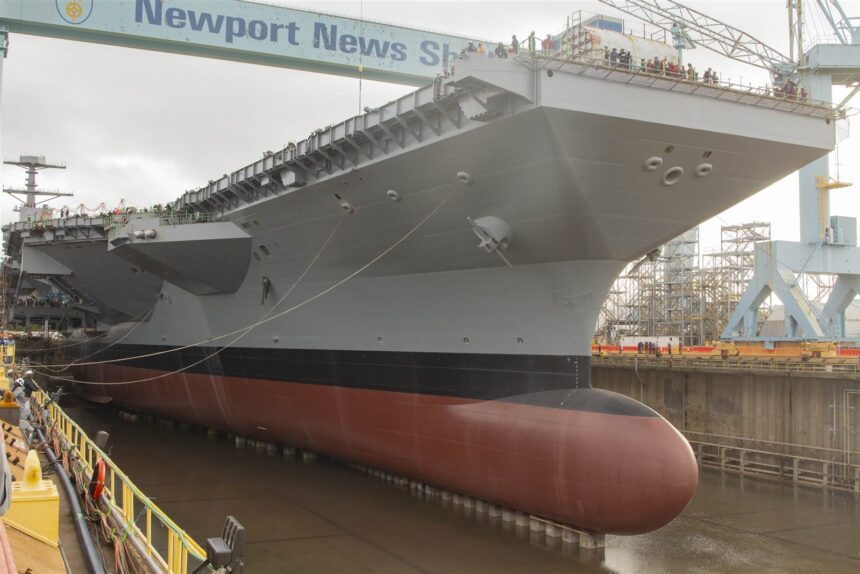
Another provision orders a plan concerning the launch and weapons-elevator systems for the future aircraft carrier CVN-81. The review does not itself replace those systems, but it requires the Pentagon to assess timelines, resources and alternatives. That distinction is important: a presidential memorandum can set priorities, but ship designs, contracts and appropriations still require technical work and congressional oversight.
Why the Navy is under pressure
The Government Accountability Office has documented persistent delays, workforce shortages, fragile supplier networks and weak acquisition discipline across Navy and Coast Guard programs. Modern warships are among the most complex machines the government buys, and design changes made after construction begins can drive cost increases through an entire program.
GAO has also warned that investment in private shipyards needs a coherent strategy. Pouring money into isolated projects may add equipment without fixing shortages of skilled welders, electricians, engineers and supervisors. A larger fleet requires predictable demand, stable designs and suppliers that can invest with confidence.
The administration’s emphasis on competition addresses a genuine vulnerability. The United States has relatively few yards capable of building major naval vessels. When one program struggles, the Navy often has limited alternatives. More competition could improve performance, but new entrants need years to build facilities, certify workers and master nuclear or combat-system requirements.
The allied-shipbuilding debate
Supporters of allied partnerships argue that the United States should use proven expertise from countries such as Finland, South Korea and Japan while domestic capacity is rebuilt. A carefully structured agreement could bring capital, advanced production methods and supplier relationships into American yards.
Critics worry that foreign construction could weaken Buy American rules, move sensitive work abroad or become a substitute for difficult reforms at home. The memorandum attempts to answer that concern by describing foreign help as a bridge and emphasizing expansion inside the United States.
Congress should insist on enforceable domestic-investment milestones. If allied companies participate, contracts should spell out where vessels are built, how technology is protected, how American workers are trained and when U.S. suppliers take over a larger share.
Execution will decide the outcome
Washington has announced shipbuilding initiatives before. The difference between a durable industrial base and another cycle of missed goals will be execution: stable requirements, realistic schedules, transparent cost estimates and leaders who are held responsible for results.
The Navy must also balance expansion with maintenance. Adding hulls means little if too many ships are waiting for repairs or lack trained crews. A credible plan should measure deployable capacity, not simply the number of vessels authorized on paper.
Why This Matters
Sea power protects trade routes, supports American forces and deters adversaries across the Indo-Pacific and beyond. The shipbuilding workforce also supports high-skill manufacturing communities across the country. Failure carries both a national-security cost and an economic cost.
The memorandum correctly identifies the industrial base as a strategic asset. Its success will depend on whether the administration and Congress turn urgent language into disciplined procurement and long-term investment rather than another set of shifting fleet targets.
What to watch
- The NAVSEA review and any changes to acquisition authority or accountability.
- Specific allied-investment proposals and domestic production requirements.
- Congressional funding decisions in the next defense and shipbuilding bills.
- Whether the Navy reduces design changes after construction begins.
The modernization plan comes as the administration also confronts escalating technological supply chain vulnerabilities, addressed in part through tariffs aimed at shielding domestic defense production.