
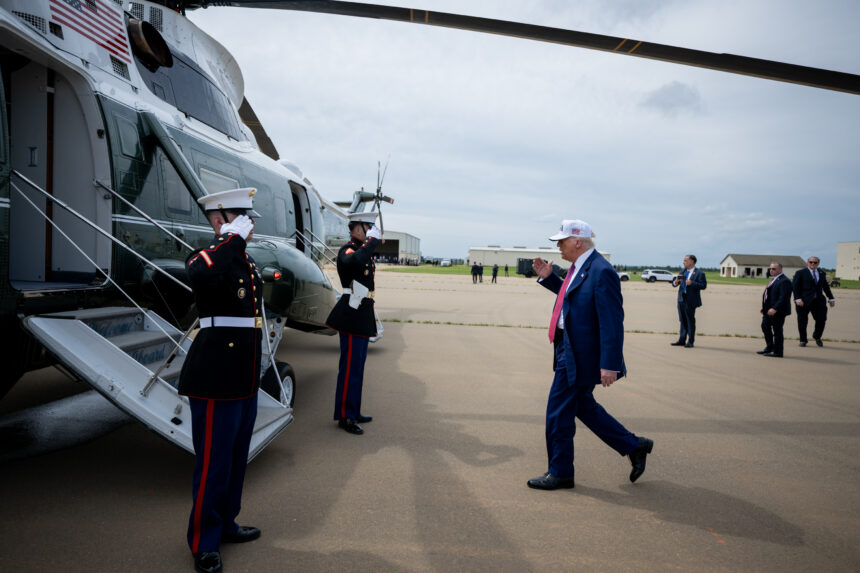
The planned eastern Iowa facility is projected to become the largest domestic steel manufacturing plant in U.S. history, anchoring federal efforts to rebuild heavy industrial infrastructure.
DES MOINES, Iowa — In a major expansion of the administration’s domestic manufacturing agenda, President Donald Trump on September 28 announced plans for a historic $15 billion commercial steel mill to be constructed in eastern Iowa by Minnesota-based industrial producer Mesabi Metallics.
The facility, designed to produce at least 7.5 million tons of finished steel annually with engineering capacity to scale to 10 million tons, is projected to be the single largest capital investment in a steel manufacturing complex ever undertaken on American soil. Construction is slated to break ground within 18 months, with initial operational output targeted for 2030.
According to economic projections released by project organizers and state commerce officials, the development will generate approximately 1,750 high-wage, permanent advanced manufacturing jobs in Iowa, supported by an estimated 5,000 to 6,000 skilled trade construction positions throughout the multi-year buildout.
“This is what putting America first looks like in action,” President Trump stated during remarks outlining the project. “For decades, politicians allowed our industrial backbone to be outsourced to foreign competitors. Today, we are bringing real steel production, real American jobs, and real industrial sovereignty back to the heartland.”

Strategic River Logistics and the Mesabi Iron Supply Chain
The decision to site the massive manufacturing complex along the eastern Iowa corridor near the Mississippi River reflects a deliberate logistical strategy. The facility will be directly integrated with Mesabi Metallics’ extensive iron ore extraction and pelletizing operations on the historic Mesabi Iron Range in northern Minnesota.
By leveraging inland river barge transport and direct rail connections, the plant will move refined iron ore pellets directly south from Minnesota to the Iowa facility, bypassing coastal shipping bottlenecks and insulating domestic steel supply chains from international maritime disruptions. The complex will utilize modern electric arc furnace technology and direct reduced iron processes to serve automotive, defense, and heavy civil construction markets.
- Annual Output: 7.5 million tons baseline capacity, scaling to 10 million metric tons at full operational maturation.
- Workforce Impact: 1,750 full-time industrial operating personnel; 5,000+ building trades personnel during peak construction phases.
- Logistical Footprint: Multimodal integration spanning Upper Mississippi River barge terminals and Class I freight rail corridors.
Midterm Political Landscape and Midwest Industrial Policy
The timing of the announcement carries significant political resonance as the November midterm elections approach. Iowa, which has increasingly solidified as a conservative stronghold, features competitive legislative and congressional contests where industrial job creation and economic growth remain paramount issues for voters.
State political leaders, including Governor Kim Reynolds, have welcomed the announcement, with state legislative leaders discussing the possibility of a targeted legislative session to finalize statutory infrastructure packages, permitting accelerations, and site preparation frameworks necessary to accommodate an industrial project of this magnitude.
Advocates of domestic tariffs contend that the $15 billion commitment demonstrates the effectiveness of Section 232 steel tariffs and broad trade protection measures in creating favorable market conditions for domestic capital deployment. Foreign steel producers facing restrictive entry tariffs have seen their market share erode, creating commercial incentives for long-term domestic capital projects.
Environmental Review and Next Steps
Despite strong political and economic momentum, the project will require extensive regulatory reviews before ground is broken. The Army Corps of Engineers, the Environmental Protection Agency, and the Iowa Department of Natural Resources will oversee comprehensive water usage, air quality, and wetland impact assessments along the Mississippi River watershed.
Mesabi Metallics executives indicated that formal permit filings will begin in the first quarter of 2027, with site engineering teams already conducting preliminary geotechnical surveys. If approved on schedule, the Iowa facility will stand as a generational benchmark for American heavy industrial revitalization.
National Security and Defense Procurement Supply Lines
Beyond consumer commercial applications, the planned Iowa facility is designed to address strategic industrial vulnerabilities identified by the Department of Defense. Under recent National Defense Authorization Act provisions, federal defense agencies are mandated to procure specialized armor plate and structural steel exclusively from certified domestic mills. In recent years, domestic military shipbuilding programs and armored combat vehicle assembly lines have faced delivery delays stemming from limited domestic rolling capacity for heavy structural grades.
By establishing modern, electric arc and direct-reduction iron infrastructure along the Mississippi River corridor, the Mesabi complex will offer dedicated production capacity for military-grade alloy specifications. Defense logistics specialists observe that establishing heavy domestic melting facilities away from coastal targets creates a more resilient industrial base capable of sustaining long-term surge capacity during international contingencies.
Sources & Official Documentation
- Federal Register – Presidential Proclamation 9705 – Adjusting Imports of Steel Into the United States Under Section 232
- Legal Information Institute (Cornell Law) – 19 U.S. Code § 1862 – Safeguarding National Security Under Section 232 of Trade Expansion Act
- Legal Information Institute (Cornell Law) – 19 U.S. Code § 2251 – Action to Facilitate Positive Adjustment to Import Competition


