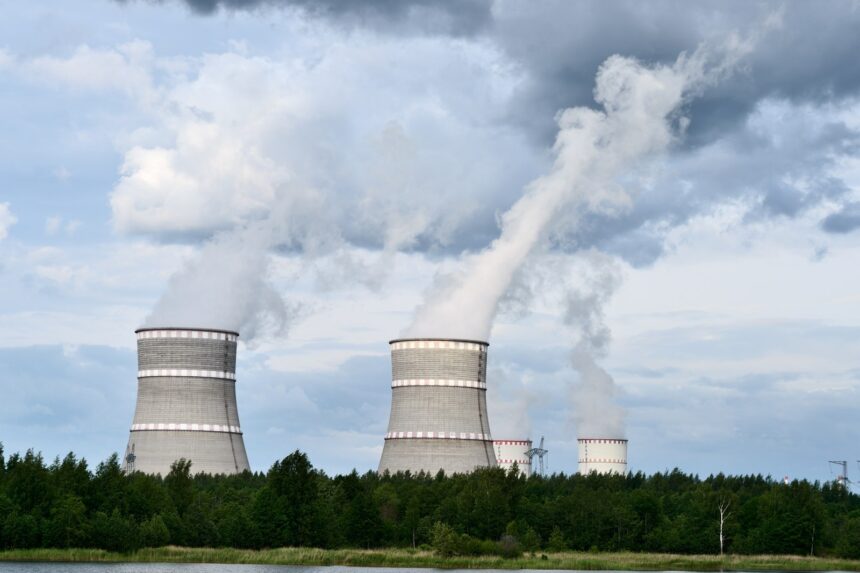
The executive directive mandates an 18-month combined construction and operating license timeline under 10 CFR Part 52 for standardized factory-built reactors co-located at retired coal plants, steel mills, and defense bases.
WASHINGTON — President Donald Trump on Sunday signed an executive directive ordering the Department of Energy (DOE), the Department of Defense, and the Nuclear Regulatory Commission (NRC) to establish an expedited 18-month licensing and siting framework for small modular nuclear reactors (SMRs) and advanced generation-IV micro-reactors deployed at domestic manufacturing hubs, hyperscale artificial intelligence data centers, and military installations.
Exercising presidential authorities under the Atomic Energy Act of 1954—codified at 42 U.S. Code § 2133 and 42 U.S. Code § 2201—the directive overhauls how federal regulators process combined construction and operating licenses (COLs) under 10 CFR Part 52. Specifically, once a reactor manufacturer obtains a standard design certification from the NRC, subsequent deployments of that identical factory-fabricated reactor module at pre-screened industrial sites will no longer be subjected to redundant, multi-year site-by-site design re-litigation.
Energy economists and defense planners have warned for years that surging electricity demand from domestic semiconductor foundries, electric-arc steelmaking, and artificial intelligence compute clusters threatens to overwhelm regional transmission grids unless the United States rapidly scales dispatchable, zero-emission nuclear baseload capacity.
Replacing Multi-Decade NRC Paperwork With Fleet-Based Licensing Under 10 CFR Part 52
Historically, the Nuclear Regulatory Commission treated every commercial reactor application under 42 U.S. Code § 2133 as a bespoke megaproject, requiring five to eight years of environmental and safety reviews and tens of millions of pages of regulatory filings before construction could even begin. While that model was built for custom 1,100-megawatt light-water reactors, industry leaders have long argued that applying identical bureaucratic timelines to 50- to 300-megawatt factory-assembled modular reactors defeats the economic purpose of modular standardization.
Under Sunday’s directive, federal agencies must implement three structural reforms to accelerate commercial nuclear deployment:
- 18-Month Combined License Ceiling for Certified Designs (10 CFR Part 52): Directs the NRC under 42 U.S. Code § 2201 to adopt a strict 18-month review clock for any combined construction and operating license application that utilizes a previously certified standard SMR design, capping hourly NRC regulatory review fees charged to domestic applicants.
- Brownfield Coal-to-Nuclear Siting Pre-Clearance: Instructs the Department of Energy to pre-certify 45 retired or retiring coal-fired power plant sites across the Midwest, Appalachia, and the Mountain West, allowing utilities to drop modular nuclear reactors directly onto existing high-voltage switchyards, cooling water intakes, and transmission corridors without new environmental impact statements.
- Domestic HALEU Fuel Supply Mobilization (42 U.S. Code § 2133): Releases $1.8 billion in federal nuclear fuel bank guarantees to expand domestic enrichment and deconversion of High-Assay Low-Enriched Uranium (HALEU) in Ohio, New Mexico, and Tennessee, permanently ending reliance on Russian state nuclear fuel corporations.
The nuclear licensing overhaul marks the latest pillar of the administration’s industrial and technological sovereignty agenda, following Friday’s executive order establishing high-speed aerospace and supersonic flight testing corridors and Wednesday’s Senate Energy Committee passage of the bipartisan Grid Reliability and Baseload Protection Act.
Powering Domestic Manufacturing, AI Compute Hubs, and Military Bases
During a Sunday briefing, senior Energy and Defense Department officials highlighted that small modular reactors are uniquely suited to provide uninterrupted, island-mode power for critical defense installations and energy-intensive industrial manufacturing. Unlike intermittent wind and solar installations that require vast land footprints and backup natural gas turbines, a dual-unit 600-megawatt SMR facility occupies less than 35 acres and operates at a 95 percent capacity factor around the clock for 60 years.
“You cannot lead the world in advanced manufacturing, steel production, and artificial intelligence if your factories are waiting seven years for an electrical interconnection permit,” the Secretary of Energy stated. “By establishing a predictable 18-month licensing pathway under 10 CFR Part 52 and repurposing retired coal switchyards, we are unleashing American nuclear engineering to power the next century of industrial growth.”
Industrial Workforce Impact and International Export Competitiveness
Labor unions representing boilermakers, pipefitters, and electrical workers—alongside the Nuclear Energy Institute and the National Association of Manufacturers—enthusiastically endorsed the directive. Economists estimate that converting retired coal plants into modular nuclear generation parks preserves up to 85 percent of existing plant operations and maintenance jobs while creating thousands of high-paying domestic pressure-vessel forging and turbine fabrication jobs.
In addition to domestic grid deployment, the directive instructs the Export-Import Bank of the United States and the International Development Finance Corporation to align export financing packages with NRC design certifications, enabling American SMR manufacturers to win commercial reactor contracts across Eastern Europe and the Indo-Pacific over Russian and Chinese state-owned competitors.
Sources & Official Documentation
- Legal Information Institute (Cornell Law School) – 42 U.S. Code § 2133 – Atomic Energy Act Commercial Licenses for Utilization and Production Facilities
- Legal Information Institute (Cornell Law School) – 42 U.S. Code § 2201 – General Duties and Regulatory Authority of the Nuclear Regulatory Commission
- Electronic Code of Federal Regulations (eCFR) – 10 CFR Part 52 – Nuclear Regulatory Commission Licenses, Standard Design Certifications, and Combined Approvals