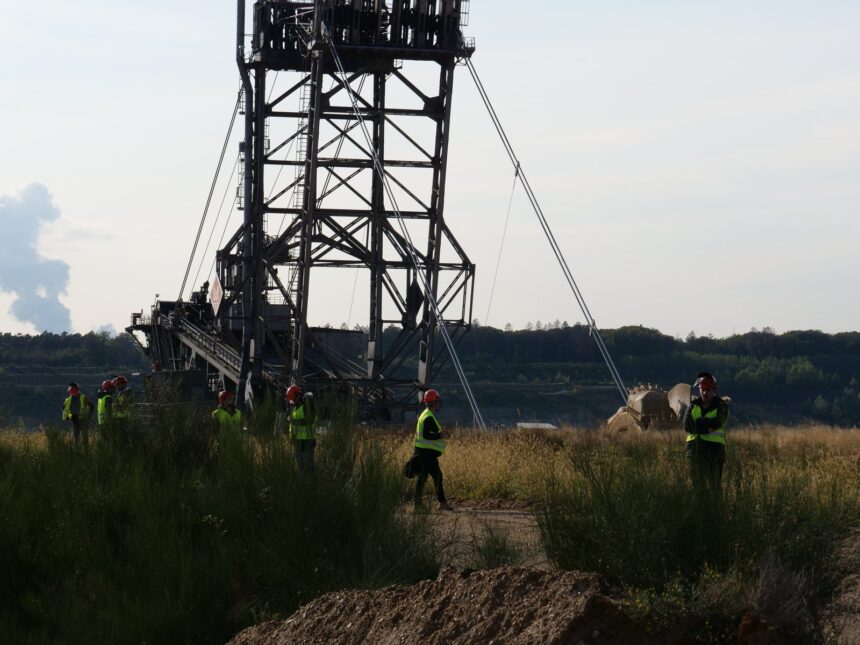
The presidential determination establishes a $1.8 billion defense procurement fund to break foreign supply dominance over battery cells, grid transformers, and aerospace magnets.
WASHINGTON — President Donald Trump on Friday signed a sweeping presidential determination invoking Title III of the Defense Production Act (50 U.S. Code § 4533), directing the Department of Defense and Department of Energy to immediately accelerate domestic mining, separation, and commercial refining of critical minerals, rare earth elements, and advanced battery materials.
The directive targets critical mineral vulnerabilities that national security officials describe as severe structural chokepoints for the American military and domestic electrical power infrastructure. Specifically, the order mobilizes $1.8 billion in defense loans, multi-year purchase guarantees, and priority procurement authorities to expand domestic refining capacity for battery-grade lithium carbonate, neodymium-praseodymium permanent magnets, cobalt, nickel, and synthetic graphite.
By declaring domestic processing of critical minerals essential to national defense under statutory emergency powers, the executive action instructs the Bureau of Land Management (BLM) and the Forest Service to establish expedited 60-day interagency permitting timelines for active extraction and refining projects located on federal lands across Nevada, Utah, Wyoming, and Alaska.

Ending Foreign Leverage Over Critical Industrial Supply Chains
The strategic catalyst behind the executive invocation centers on global supply chain concentration. Despite possessing substantial geologic deposits within the United States, American industry currently relies on overseas refineries—predominantly controlled by geopolitical competitors in East Asia—for more than 80 percent of refined rare earth permanent magnets and over 70 percent of chemical-grade lithium.
These advanced components are not merely consumer battery inputs; they represent irreplaceable hardware within advanced guidance systems for precision missiles, Virginia-class nuclear submarine propulsion drives, F-35 fighter jet avionics, and high-voltage electrical substation transformers that maintain the civilian electric grid.
“For decades, globalist trade policies exported America’s mineral wealth and industrial independence overseas, leaving our military and our electric power grid completely dependent on foreign adversaries for the basic raw materials that power modern civilization,” President Trump said during the signing ceremony in the Oval Office. “With this order, we are reclaiming American resource dominance. We have the richest mineral reserves in the world, and we are going to mine them, refine them, and manufacture them right here on American soil.”
Title III Financing Mechanics and Long-Term Offtake Agreements
Under Title III of the Defense Production Act, the Department of Defense is legally empowered to issue direct capital loans, install government-owned equipment at commercial processing facilities, and guarantee purchase prices over multi-year horizons to insulate domestic operators from foreign market price-dumping strategies.
Federal officials confirmed that the $1.8 billion capital reserve will be structured across three key investment tracks:
- Direct Mineral Refining Loans ($950 Million): Low-interest senior secured loans for commercial extraction facilities in the Great Basin and Clayton Valley to construct high-throughput chemical separation plants.
- Strategic Magnet and Metallurgy Reserves ($550 Million): Forward procurement contracts authorizing the Defense Logistics Agency (DLA) to stockpile refined neodymium magnets and dysprosium alloys at national defense depots.
- Grid Infrastructure Transformer Allotment ($300 Million): Targeted subsidies to domestic steel and electrical equipment manufacturers to build grain-oriented electrical steel (GOES) cores for high-voltage transmission substations.
The initiative complements recent federal measures intended to overhaul national energy reliability, echoing the administration’s aggressive policy initiatives to reform nuclear energy licensing frameworks and expand domestic baseload power production.
Interagency Permitting and State Resource Cooperation
To eliminate procedural bottlenecks, the presidential order directs the Council on Environmental Quality (CEQ) and the Department of the Interior to implement categorical exclusions under the National Environmental Policy Act (NEPA) for refining facilities built adjacent to existing active mining claims governed by 43 CFR Part 3800.
Western governors and state mining associations welcomed the federal capital deployment, noting that while discovery and exploratory drilling in Western states have proven extensive deposits, complex multi-agency permitting processes historically required seven to twelve years before commercial processing could commence.
The Department of Defense confirmed that initial grant solicitations and loan applications will open through the Defense Logistics Agency portal on November 2, 2026, with the first commercial capital awards expected before the end of the calendar year.
Water Rights, Local Geopolitics, and Processing Refinery Economics
The operational bottleneck in critical mineral independence extends far beyond finding geologic deposits; it centers on the intensive chemical processing and hydrometallurgical refining required to produce battery-grade materials. In the Great Basin and Clayton Valley of Nevada, commercial operators face acute competition for scarce groundwater allocations essential for brine evaporation and lithium carbonate precipitation.
By leveraging Title III authorities, the administration is providing matching capital grants to finance closed-loop direct lithium extraction (DLE) technologies that reinject spent brine into deep aquifers, reducing freshwater consumption by up to 90 percent. Furthermore, federal purchase agreements guarantee minimum price floors for domestic refiners, protecting American capital investments against targeted market-flooding maneuvers by state-subsidized foreign mining conglomerates.
Sources & Official Documentation
- Legal Information Institute (Cornell Law School) – 50 U.S. Code § 4533 – Defense Production Act: Presidential Determinations and Expansion of Productive Capacity
- Legal Information Institute (Cornell Law School) – 30 U.S. Code § 1606 – Critical Minerals Supply Security, Management, and Domestic Supply Chains
- Electronic Code of Federal Regulations (eCFR) – 43 CFR Part 3800 – Bureau of Land Management Regulations for Operations on Federal Mining Claims