A federal judge dismissed an environmental coalition lawsuit challenging President Trump’s rescission of offshore drilling bans in Arctic and Alaska coastal waters.
ANCHORAGE, Alaska — A federal judge in Alaska has dismissed a major lawsuit brought by a coalition of environmental organizations challenging President Donald Trump’s executive actions that rescinded Biden-era leasing bans across the Outer Continental Shelf in Arctic and Alaskan coastal waters, delivering a significant legal victory for domestic energy producers.
In her memorandum decision, U.S. District Judge Sharon L. Gleason of the District of Alaska granted motions filed by the Department of Justice and state industry intervenors, concluding that the environmental groups’ legal challenge was premature and that plaintiffs failed to establish the imminent constitutional injury required for federal court standing.
Outer Continental Shelf Leasing and Presidential Directives
The legal battle centered on President Trump’s executive directives reopening millions of acres across the Beaufort Sea, Chukchi Sea, and Cook Inlet to commercial oil and natural gas leasing. Those offshore areas had previously been placed under broad administrative withdrawals by the previous administration under Section 12(a) of the Outer Continental Shelf Lands Act (OCSLA).
Environmental groups, including the Northern Alaska Environmental Center, contended that presidential withdrawals under OCSLA are permanent and cannot be reversed by subsequent executive action without explicit congressional legislation. They argued that reopening Arctic waters threatened sensitive marine ecosystems, subsistence hunting resources, and long-term climate targets, asserting that drilling in harsh polar environments carries unacceptable ecological risks.
The judicial victory aligns with the administration’s broader push to accelerate domestic mineral and energy extraction, complementing executive initiatives aimed at overhauling federal energy permitting standards and asserting emergency executive authority to strengthen national electrical grids.
Court Rationale and Standing Doctrine
In her ruling, Judge Gleason determined that because the federal government has not yet approved specific lease sales, exploration permits, or exploratory drilling applications in the contested offshore zones, the environmental organizations could not demonstrate direct, non-speculative injury.
The Justice Department’s Environment and Natural Resources Division (ENRD) argued successfully that potential environmental impacts must be evaluated through standard multi-stage regulatory reviews when specific commercial exploration plans are actually submitted to the Bureau of Ocean Energy Management (BOEM).
By dismissing the case on procedural standing grounds, the court avoided ruling on the broader constitutional question of presidential withdrawal powers, leaving the administration’s leasing framework fully operational while permitting environmental groups to challenge future individual lease sales if development permits are formally authorized by federal regulators.
Economic Significance for Alaska and Domestic Energy
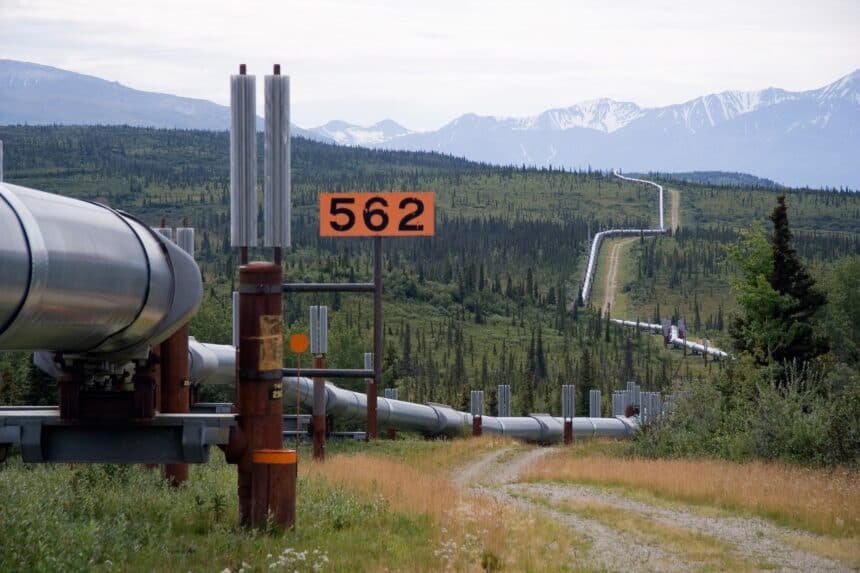
Alaska state officials and energy industry consortiums welcomed the dismissal, emphasizing that expanding offshore resource development is critical to sustaining throughput in the Trans-Alaska Pipeline System and generating essential state royalty revenues.
Industry leaders noted that offshore Alaskan reserves represent some of the most prolific undiscovered conventional energy basins in North America, providing vital long-term energy security for American allies and domestic markets alike during periods of global geopolitical tension.
State economic planners emphasized that responsible resource exploration creates high-paying engineering and maritime jobs, providing critical funding for rural Alaskan infrastructure, local educational districts, and community healthcare initiatives across the North Slope and Kenai Peninsula.
Energy analysts pointed out that maintaining robust throughput through the 800-mile Trans-Alaska Pipeline is essential to preventing mechanical cooling and operational wax buildup, making ongoing exploration in adjacent outer continental shelf basins vital to Alaska’s long-term fiscal stability and national energy independence.
What Happens Next
The Department of the Interior is expected to proceed with publishing revised five-year offshore leasing schedules, identifying specific lease tracts in the Beaufort Sea and Cook Inlet for competitive bidding by qualified energy operators.
Environmental organizations have indicated they will closely monitor the regulatory process and prepare targeted legal challenges under the National Environmental Policy Act (NEPA) and the Endangered Species Act as soon as specific lease sale notices are formally gazetted.
The dismissal clears the way for preliminary geophysical surveys during the upcoming summer navigation season, allowing exploration teams to map subsurface geological formations across the outer continental shelf.
Sources
- U.S. District Court for the District of Alaska: Order Granting Motions to Dismiss in League of Conservation Voters v. Trump
- U.S. Department of Justice — ENRD: Official Litigation Filings on Alaska Outer Continental Shelf Energy Development
- Offshore Technology: Federal Court Dismisses Environmental Challenge to Alaska OCS Leasing
- Saving Seafood / Daily Record: Coverage of Federal Judge Gleason Decision on Arctic Offshore Drilling